Biometric EID Tag · Product report · October 2026
Add the data.Keep the tag she has.
A reusable sensor designed to pair with the official EID tag she already wears, and to move on to the next animal when she leaves the herd.
At a glance
More data per head.None of the barn hardware.
Her official tag carries one number. Mule's ear devices are designed to add how she eats, rests, ruminates and moves, and to tell you each morning which animals to check first. You read it all with the phone you already carry: no towers, antennas or barn receivers to buy.
Pilot farms from 2027. Pilot equipment is lent free of charge.
What you get, and what it takes
- Official EID tag
- What it gives you:
- ID number
- What it needs on the farm: A wand or panel reader
- Most activity monitors
- What it gives you:
- Behavior
- Heat and health alerts
- What it needs on the farm: Towers, antennas or barn receivers
- Mule, as designed
- What it gives you:
- ID number
- Behavior
- Who to check first
- Heat load
- Treatments
- Moves and sale
- What it needs on the farm: The phone you already carry
- What they track
01 · Health
Know who to check first.
About a third of preweaned dairy heifers get sick at least once. Mule's devices are designed to learn each animal's own normal and put the ones drifting from it on a short list each morning. The light at the ear says look; you and your vet decide.
Source · USDA NAHMS Dairy 2014 · pub. 2021
- What it could be worth
02 · Cost
Designed to cost less to run.
Nothing to mount in the barn and nothing to retag. Companion by Mule pairs with the official tag she already wears, and when she leaves the herd it moves on to the next animal.
- Meet 840 by Mule
03 · Different
Nothing like it on the official list.
None of the official 840 ear tags APHIS lists today carries a battery or a sensor. 840 by Mule is being designed as the official tag with the sensing built in. Approval is planned, not filed.
Source · USDA APHIS, AIN devices with the 840 prefix · 21 Oct 2026
01Executive summary
The short version.
- The problemOn a farm with hundreds of animals, the one that needs attention today is easy to miss. Calf sickness is common and costly, and most of what happens to an animal is never written down in a form that leaves the farm with her.
- The productTwo ear devices on one record. Companion by Mule pairs with the official tag an animal already wears and moves on to the next animal; 840 by Mule is being designed as an official 840 tag with the sensing built in. Both are designed to learn each animal's normal, rank the ones worth a closer look each morning, and carry a signed, tamper-evident history.
- Why nowElectronic ID is now part of the rules for moving certain US cattle between states, the EU already runs national registers for every bovine, and buyers pay more for animals with verified records.
- Why MuleOne team builds the tag, the phone app and the record platform behind it. The tag is designed to work with official EID, to be read with a phone, to keep working offline and to leave the data with the farm.
- Where we areIn development: design and prototypes now, pilot farms from 2027 with veterinary-confirmed outcomes, and certification planned, not filed. The Companion needs FCC authorization; the 840 also needs APHIS approval as an official tag. We publish no specifications or prices until pilots and certification support them.
- What we are looking forPilot farms, veterinary and research partners, and conversations with funders and grant programs.
Headline figures
9.57MHEAD
US milk cows on 1 January 2026, up 2% on a year earlier.
Source · USDA NASS, Cattle · 30 Jan 2026
19.0MHEAD
Dairy cows in the EU-27 at the end-2025 survey, 1.1% fewer than a year earlier.
33.8%
Preweaned dairy heifers that get sick at least once. 5.0% die, at an average age of 24 days.
Source · USDA NAHMS Dairy 2014 · pub. 2021
5 Nov 2024
Since this date, official ear tags for interstate movement of dairy cattle must be visually and electronically readable.
02Why now
Fewer animals, worth more each.
The US herd is the smallest it has been since 1951, and the animals left set price records in spring 2026. When each head is worth more, every animal lost, missed or unproven costs more.
Fig. 02.1 · US cattle and calves on 1 January
Line chart in million head, 2019 to 2026, falling every year.
Million head, as first published each January. Down 8.6M head from 2019 to 2026.
Fig. 02.2 · Feeder steers at Oklahoma City
Bar chart in dollars per hundredweight: February 2024 average, June 2025 average, May 2026 record, USDA 2026 forecast.
$ per cwt, 750 to 800 lb steers. A 775 lb steer went from about $1,871 to $3,007.
Source · USDA ERS outlook; USDA AMS via trade press · Feb 2024-May 2026
Source · USDA AMS via trade press · May 2026
03The problem
The animal that needs you is easy to miss.
Every morning someone walks the pens and decides which animals to look at more closely. It is skilled work, done by eye, against the clock, and the record of what was seen rarely survives the day.
Calves carry the heaviest load. In the last national US dairy study, about a third of preweaned heifers got sick at least once, and one in twenty died. One in eight calves had poor passive immunity, the failure that tends to show up as sickness weeks later.
The cost runs past the treatment. A respiratory case before weaning adds a cost by first calving several times larger than the cost of treating it. And when a calf is sold, its history usually stays behind: the buyer pays for what they can see.
Fig. 03.1 · Per 100 preweaned dairy heifers
Bar chart per 100 heifers: sick at least once, digestive signs, respiratory signs, poor passive immunity, died.
Heifers out of 100
Source · USDA NAHMS Dairy 2014 · pub. 2021
Source · NAHMS Dairy 2014 calf component, J Dairy Sci · pub. 2020
Fig. 03.2 · One respiratory case before weaning
Treatment is the small part of the bill.
Treatment is the small part of the bill.
Source · Dubrovsky et al., J Dairy Sci · 2020
Fig. 03.3 · Weight lost on the truck
Body weight cattle can lose in the first hours of a haul. Calves can shrink 5 to 8% on a five-hour trip.
Pounds lost in transit are pounds not paid for.
Source · SDSU Extension · rule of thumb
$252-282
Added cost of a preweaned BRD case by first calving, on top of about $42 to treat (11,470 California calves).
Source · Dubrovsky et al., J Dairy Sci · 2020
What a case costs. Treatment is the small part of the bill. The larger part arrives later, in growth and in the first lactation.
04What it could be worth
One example farm, in money and hours.
A farm raising 500 calves a year, run through the national averages above and cautious assumptions. The published rates come from the sources cited; the shares avoided, sale weight and minutes per task are assumptions, stated in full below the charts.
Fig. 04.1 · About $44,100 a year at risk; about $9,000 estimated back
Paired bars per line: respiratory cases, deaths and verified premium, showing the amount at risk and the amount estimated back.
Source · NAHMS Dairy 2014 calf component, J Dairy Sci · pub. 2020
Source · Dubrovsky et al., J Dairy Sci · 2020
Source · USDA NAHMS Dairy 2014 · pub. 2021
Source · USDA AMS, New Holland auction report · 12 Oct 2026
Source · Beef Magazine · UC Davis · 2024
Fig. 04.2 · About 273 hours back a year, 6.8 forty-hour weeks
Bar chart of hours saved a year: record keeping, finding who to check, reports.
Hours a year
Assumptions behind the example
- 64 respiratory cases at $267 each by first calving; 15% of them caught early enough to avoid that cost.
- 25 calf deaths at $1,086 each, today's average calf value; 10% of them avoided.
- 50% of calves sold with verified age and source at 600 lb, earning $2.50/cwt.
- 8 record events per animal a year, 4 minutes each by hand against 1 by scan and tap.
- 45 minutes a day spent finding which animals to check; a morning short list saves 20% of it.
- 6 registration, movement or sale reports a month at 20 minutes each, 75% prepared from the record.
An illustrative estimate, not a Mule result or a promise of one. The tag is in development; pilots from 2027 will measure the real effect, and we will publish what they show.
05Market and timing
Large herds, new rules, a premium on proof.
The tag is built for the herds Mule already serves in the United States and the European Union. We do not publish a market-size estimate; these are the herds and the rules the product is designed around.
Fig. 3 · Herds the tag is designed for
Horizontal bar chart in millions of head: US cattle and calves, US milk cows, EU bovine animals, EU dairy cows.
Millions of head
US figures as of 1 January 2026; EU figures from the end-2025 livestock survey.
Source · USDA NASS, Cattle · 30 Jan 2026
Tailwinds
5 Nov 2024
Since this date, official ear tags for interstate movement of dairy cattle must be visually and electronically readable.
$1-4/CWT
Premium reported for age- and source-verified calves. Requires an audited USDA program.
Source · Beef Magazine · UC Davis · 2024
0.8%
Cow-calf operations using EID in the last national beef study, while 90% of US milk comes from farms with individual cow records.
Source · USDA NAHMS Beef · latest
06Two devices
Two ways onto the animal. One record behind both.
US rules allow one official ear tag per animal, and most animals a farm owns already wear theirs. So Mule is building two devices on the same sensing, app and record: one that joins the tag she already has, and one that is her official tag from the first day.
| Two devices | Companion by Mule | 840 by Mule |
|---|---|---|
| What it is | A separate, reusable sensor that pairs with the animal's existing official tag | An official 840 EID ear tag with the sensing built in |
| Which animals | Animals already carrying their official tag: the herd a farm owns today | Animals getting their first official tag, such as calves at tagging |
| Official ID | Never; it shows the official number but does not replace the tag | Designed to be the animal's official identification |
| Moves between animals | Yes, with a new fitting piece each time | No; an official tag stays with the animal for life |
| Before sale | FCC authorization | ICAR testing, an APHIS field trial and approval, and FCC authorization |
| Status | In development; US pilots from 2027 | In development; approval planned, not filed |
Two paths to market
The Companion can reach farms on the shorter path while the 840 goes through official approval. What the Companion learns in the field feeds the 840.
Companion by Mule
- 01Design and prototypes
- 02US pilot farms, 2027
- 03FCC authorization
- 04Sale and lease
840 by Mule
- 01Design and prototypes
- 02ICAR testing
- 03APHIS field trial, 36 months
- 04Official approval and sale
Status, not promises. Nothing is filed yet; we publish each step as it starts.
The rules that shape the plan
1PER ANIMAL
Official eartags allowed on one animal, with listed exceptions. Any other ear device has to be non-official.
Source · 9 CFR 86.4(c) · in force
0
Battery-powered or sensor ear tags on the APHIS list of official 840 devices. All listed tags, from 10 makers, are passive.
Source · USDA APHIS, AIN devices with the 840 prefix · 21 Oct 2026
36MONTHS
APHIS field trial for a new official eartag, on at least 300 cattle at two or more sites. Limited sales from month 6 and unlimited from month 12 if every assessment passes.
Source · USDA APHIS, Official Animal ID Device Standards v3.1 · 5 Nov 2024
€27,955
ICAR test fees, as a non-member, for the conformance, performance and laboratory tests of an RFID ear tag that APHIS asks for.
Source · ICAR price list 2026 · 2026
07Companion by Mule
A sensor for the tag she already wears.
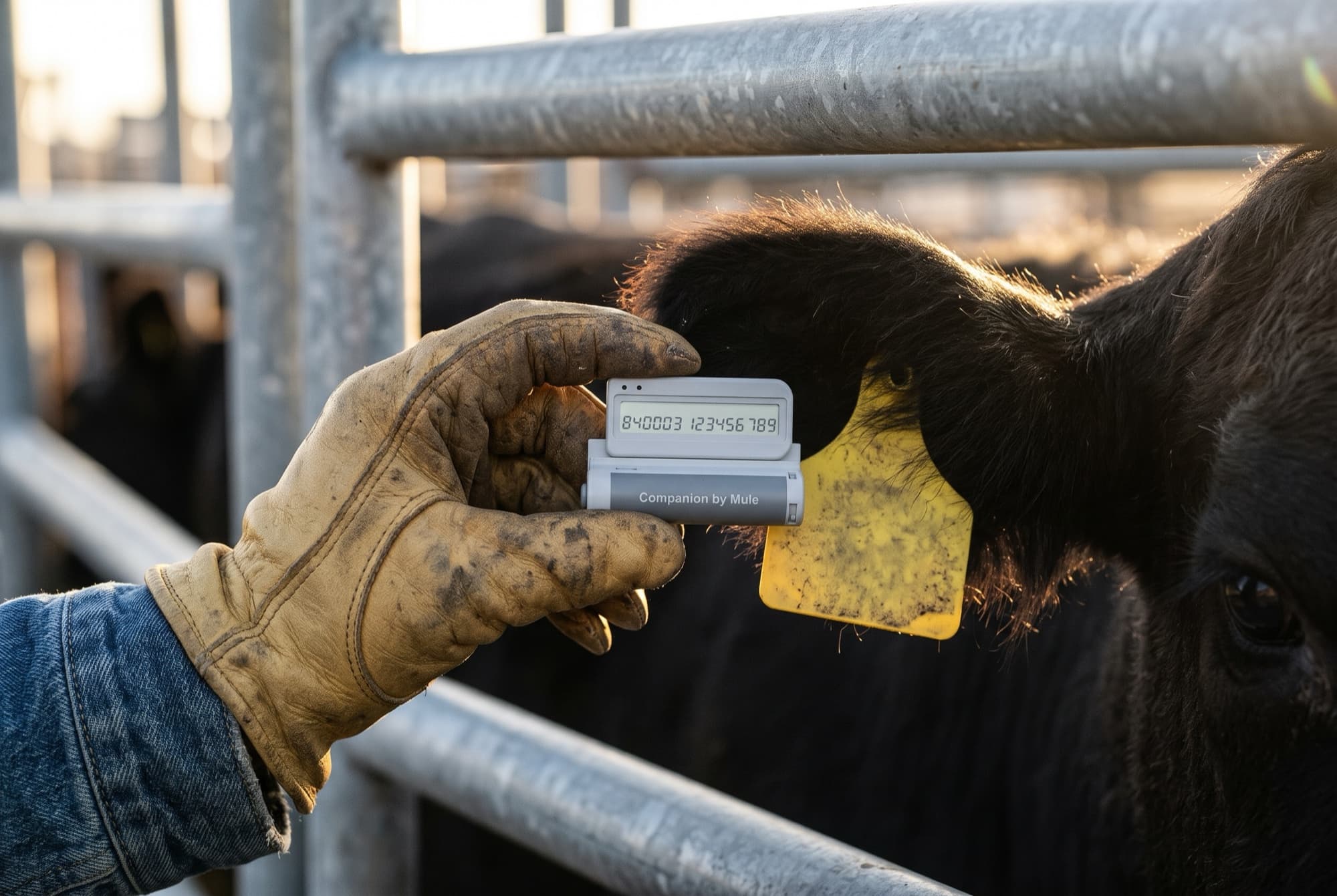
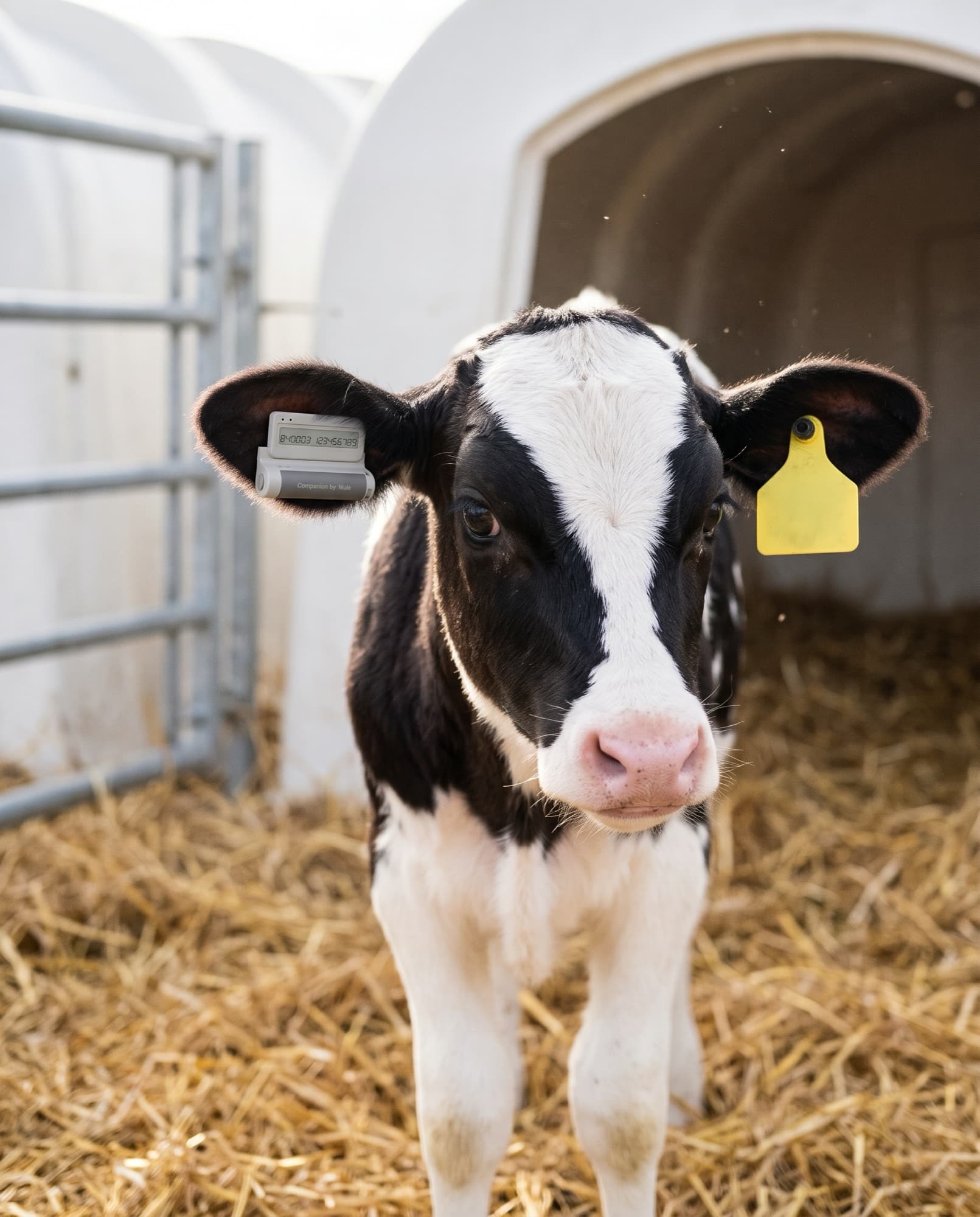
Companion by Mule is designed for the animals already in the herd. It goes in its own hole beside the official tag, reads that tag's number once, shows it on its display and keeps the two linked in the record. The official tag is never touched.
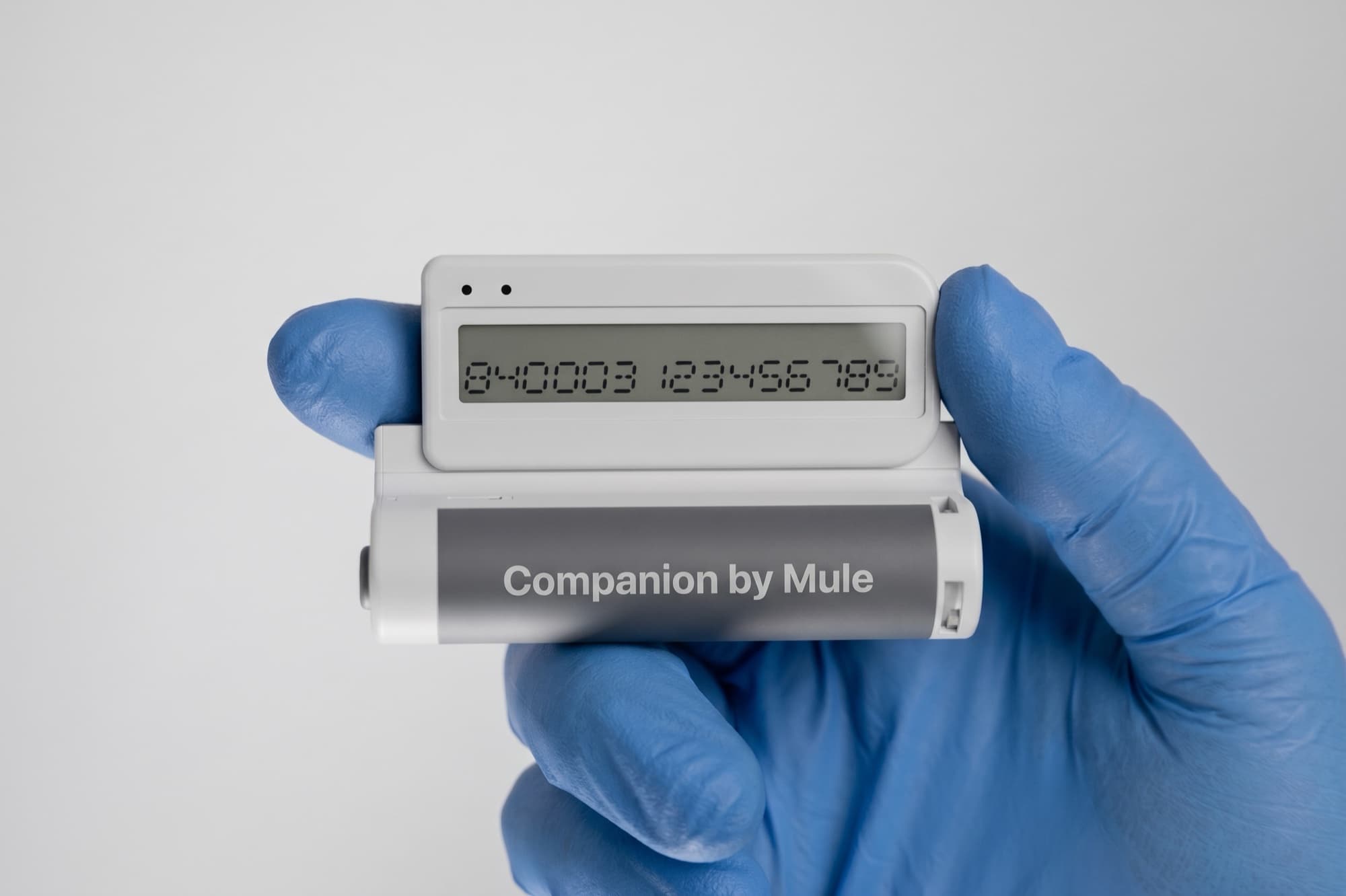
How a farm would use it
From fitting to the next animal, as designed.
- 01 · FitIts own holeFitted with its own pin, away from the official tag, never through it or clipped onto it.
- 02 · PairOne touchHold its back against the official tag. It reads the number, shows it on the display, and the app records the link.
- 03 · WorkLearns her normalFrom then on the display shows only her official number, while the sensing builds her baseline and the morning short list.
- 04 · MoveNext animalWhen she is sold or culled, unpair it, change the battery if needed and fit it to the next animal with a new fitting piece.
Why it matters
9.57MHEAD
US milk cows on 1 January 2026, up 2% on a year earlier.
Source · USDA NASS, Cattle · 30 Jan 2026
86.2MHEAD
US cattle and calves on 1 January 2026, the smallest January herd since 1951.
Source · USDA NASS, Cattle · 30 Jan 2026
08840 by Mule
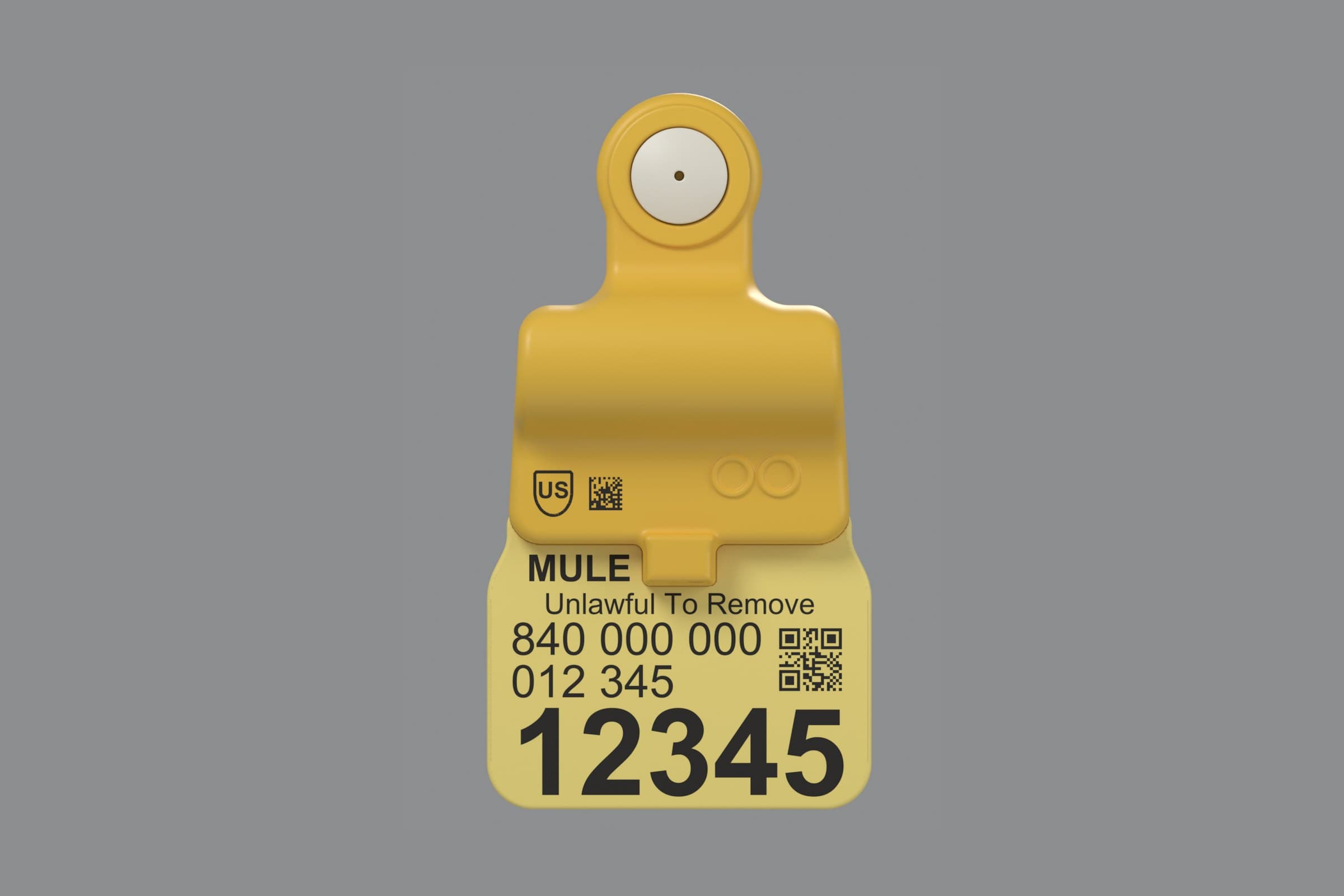
The official tag, with the sensing built in.
840 by Mule is being designed to carry the animal's official 840 number, readable by eye and by any EID reader, together with the sensing and the record. It is the device for first tagging, and the one we plan to submit to USDA APHIS for approval as an official identification device. Nothing is filed yet.
Why it is worth the longer road
0
Battery-powered or sensor ear tags on the APHIS list of official 840 devices. All listed tags, from 10 makers, are passive.
Source · USDA APHIS, AIN devices with the 840 prefix · 21 Oct 2026
5 Nov 2024
Since this date, official ear tags for interstate movement of dairy cattle must be visually and electronically readable.
09What they do
Two devices, one record, one short list.
What both devices are designed to do, in outcomes rather than a spec sheet. We publish no specifications, battery life, range, sensor list or price at this stage.
What biometric means here
Biometric, on this page, means body and behavior signals of the animal: how she moves, eats, rests and ruminates, and the conditions around her. It is not face recognition, and it is not a medical device.
The tag is designed to compare every animal with her own baseline and with her pen-mates, so that when her pattern shifts, she moves up the morning short list. The light means look, never treat: what to do stays with you and your vet.
What both devices are being designed to do
Ten intended outcomes, no spec sheet. Pilots from 2027 will test each one.
- 01See who to check firstDesigned to give a ranked short list each morning, not a wall of alarms.
- 02Her normal, not the herd'sDesigned to compare each animal with herself and with her pen-mates.
- 03A light at the earIntended to signal "take a look" at the ear, without a phone or a signal.
- 04No barn hardwareDesigned to be read with the phone you already carry.
- 05Time budgets you can act onIntended to track rumination, eating and resting patterns, for you and your nutritionist.
- 06Heat cycles and breeding windowsIntended to help time breeding, alongside your current program.
- 07Heat load, animal by animalDesigned to read conditions where the animal is, not at the barn door.
- 08A history that moves with herDesigned to carry a lifetime record through sale and transfer.
- 09Proof it hasn't been alteredDesigned to keep signed, tamper-evident records a buyer or auditor can check.
- 10Test changes on your farmIntended to compare a ration or protocol change against an untreated group.
Walk the pen
Walk the pen. Know the pen.
Designed so each tag's status arrives on your phone as you walk past, with a readout that says how she compares with her own normal, in plain words.
840 · USA · Example
Illustration · fictional ID- Read
- OK · 0.38 s
- Pen
- 4 · calf program · day 11
- Status
- normal for her · confidence 0.92
- Synced
- 06:12 CST
How it works
From the ear to the decision, as designed.
- 01 · On the animalLearns her normalDesigned to record continuously, with or without signal.
- 02 · In the penWalk and readWalk through with the Mule app; each tag's status is designed to arrive as you go.
- 03 · On the platformComparePen-mates, pen-wide changes, your trials.
- 04 · Into decisionsAct and proveCheck lists, vet reports, a verifiable record at sale. Data leaves only when you choose.
10The system
One tag, one record, one network.
The tag is the sensor end of the Mule record platform. Her history, her status and her paperwork live on one record that follows her from the dairy to the feedlot and back. Every handoff adds to it; nobody starts from a blank sheet.
Diagram: five stages from dairy to buyer, each adding to one record, with outcome data returning to the farm.
- DairyBorn and fedBirth, dam, colostrum and first treatments go on the record at the hutch.
- Calf raiserRaisedA morning short list for the weeks of highest risk; treatments and withdrawal tracked.
- HaulerMovedEvery load signed for, with times, conditions and who had the animal.
- Grower and feedlotGrown outArrival history in hand and costs rolled up per head.
- Buyer and packerSoldA signed origin and health history to check before purchase.
Outcomes return to the farm: closeout and carcass data back to the dairy.
The record systems run today. The tag joins them from the 2027 pilots.
11Why Mule
A tag is only as useful as the record behind it.
Mule builds livestock record systems: calves, health, traceability and transport. The tag is the sensor end of the same record, not a separate gadget with its own silo.
12Landscape
What farms use today, and the gap.
Farms already use good tools. Each does one part of the job well; the gap is in joining identity, behavior and a record that travels.
Fig. 12.1 · So far, more data has meant more hardware. The Mule tag is designed to break that.
Scatter chart. Horizontal: infrastructure each system needs to run, from nothing on the farm to barn receivers and a local server. Vertical: what it collects, from an ID number only to behavior plus the animal's full record. The Mule tag sits alone at the top left.
Placed from each maker's published descriptions and trade press; levels are ordered categories, not measurements, and maker claims are not independent tests. These systems ship today and most send data continuously. The Mule tag is in development and is read by phone as you walk the pen; the light at the ear is designed to cover the hours in between.
What each one needs, and what it collects
| System | What it needs to run | What it collects |
|---|---|---|
| Mule tag (designed, pilots 2027) | The phone you already carry; no barn hardware. | Designed for movement, eating, resting, rumination and conditions, on one record with treatments, moves and sale. |
| Ceres Tag | Nothing on the farm; sends direct to satellite. | GPS location, activity, temperature. |
| Official RFID EID tag | A handheld or panel reader. | An ID number. |
| Halter (collar) | Solar towers on the property. | Location, grazing, rumination, heat. A collar, not a tag. |
| SenseHub (MSD / Allflex) | Antennas or readers where animals visit daily, and a base station. | Rumination, eating, activity, every 20 minutes. |
| CowManager | Routers about 100 m apart with line of sight, a coordinator and a farm computer. | Activity, ear temperature, eating, rumination, resting, location. |
| Smartbow (Zoetis) | Receivers mounted in the barn, sending to a local server. | Rumination, heat, real-time location in the barn. |
| Category | What it does well | Gap the tag addresses | Mule's approach |
|---|---|---|---|
| Visual ID tags | Cheap, universal and readable by eye at a distance. | Carry a number only. Everything else lives on paper or in separate software. | Keep the visual number; add a record and a behavior signal behind it. |
| RFID-only EID tags | Electronic official ID, read at the chute or the sale barn, and part of movement rules. | An ID number, nothing more. No behavior signal and no history carried with the animal. | Designed to work with official EID, not replace it, and to add signals and a signed history. |
| Collar and ear-tag activity and rumination monitors | Widely used in dairies for heat and behavior alerts across the herd. | Usually a second device next to the official ID, and the data tends to stay in that system. | One record across tag, treatments, movements and sale, read with a phone and exportable by the farm. |
| Herd management software | The farm's book of record for breeding, health and production. | Much is typed in by hand, and the record rarely leaves the farm with the animal. | Integrations with common herd systems are planned; the record travels at sale on the farm's say-so. |
13Livestock data, in depth
What the public data says, and what we build for it.
The same problems show up across USDA, Eurostat and published research. Each comes down to a record that is missing, late, or stuck on one farm.
Dairies keep cow records. Almost nobody measures the calf.
Nine in ten gallons of US milk come from farms with individual cow records, yet few producers measure colostrum, and EID is close to absent on beef operations.
Fig. 13.1 · Share of producers or milk
Bar chart in percent: milk from farms with individual cow records, producers using a colostrometer, producers using a Brix refractometer, cow-calf operations using EID.
Source · USDA NAHMS · latest
Source · USDA NAHMS Dairy 2014 · pub. 2021
Source · USDA NAHMS Beef · latest
Regulators run on clocks.
Registrations, transport limits and electronic ID rules set deadlines in days and hours, and calves change hands young.
3WORKING DAYS
The Netherlands: report a calf to RVO I&R within 3 working days.
Source · RVO, Identificatie en Registratie · 2026
7DAYS
Belgium: register a calf in Sanitel within 7 days of birth.
Source · FAVV / AFSCA · Sanitel · 2026
9 h · 1 h · 9 h
EU Reg. (EC) 1/2005: unweaned calves travel 9 hours, rest 1, travel 9. Under 10 days old, no more than 100 km.
Source · Council Regulation (EC) No 1/2005 · in force
28HOURS
US limit on confinement in transit without 5 hours of rest, feed and water (36 on written request).
Source · 49 U.S.C. 80502 · in force
5 Nov 2024
Since this date, official ear tags for interstate movement of dairy cattle must be visually and electronically readable.
Herds getting smaller, each animal worth more.
Mule works across the US Midwest, Belgium and the Netherlands, where herds are shrinking and the record per animal matters more each year.
Fig. 13.2 · Scale
Mule works across the US Midwest, Belgium and the Netherlands, where herds are shrinking and the record per animal matters more each year.
Source · Eurostat · May/Jun 2026
Source · USDA NASS · 1 Jan 2026
Source · Eurostat · Dec 2025
14Apps on the record
Built for everyone who touches the animal.
One record, many views. Each person in the chain sees what they need, in the field, with gloves on and no signal. The record systems run today; the tag adds to them from the 2027 pilots.
- Calf raiserCalf recordsColostrum, treatments, weights and the sale, entered at the hutch and ready for the buyer.Available now
- HaulerLoad sheetEvery load signed for at pickup and drop, with hours on the road and who had the animal.Available now
- HealthTreatment and withdrawalWhat was given, by whom, and when the animal clears withdrawal, on one screen.Available now
- TraceabilityMovements and programsEID reads, movement history and program paperwork that holds up in an audit.Available now
- Calf raiser and dairyMorning short listWho to check first in the weeks of highest risk, plus breeding windows and heat-load ranking.Pilot 2027
- VeterinarianChute-side historyAn animal's full history to support the exam, plus cohort and stewardship reports.Pilot 2027
- Buyer and processorVerified historyA signed health and origin history to check before purchase, and records for program audits.Later
- The people who eat itProof of originWhere the animal was born, raised and moved, carried by a record nobody can quietly change.Roadmap
15Why the data matters
The record is part of the animal's value.
Two animals of the same weight and breed can sell for different prices, depending on what you can prove about them. These are the ways a good record pays.
$1-4/CWT
Premium reported for age- and source-verified calves. Requires an audited USDA program.
Source · Beef Magazine · UC Davis · 2024
$377
Extra a beef-on-dairy calf brought over a dairy calf at New Holland, PA, week ending 21 March 2026 (80 to 89 lb).
Source · Southern Ag Today · 31 Mar 2026
$252-282
Added cost of a preweaned BRD case by first calving, on top of about $42 to treat (11,470 California calves).
Source · Dubrovsky et al., J Dairy Sci · 2020
5 Nov 2024
Since this date, official ear tags for interstate movement of dairy cattle must be visually and electronically readable.
~1%/HR
Body weight cattle can lose in the first hours of a haul. Calves can shrink 5 to 8% on a five-hour trip.
Source · SDSU Extension · rule of thumb
0.8%
Cow-calf operations using EID in the last national beef study, while 90% of US milk comes from farms with individual cow records.
Source · USDA NAHMS Beef · latest
How a record builds over seasons
- Season 1A baselineEach animal's normal, and your farm's real numbers.
- Season 2ComparisonsThis year against last, pen against pen, ration against ration.
- Season 3DecisionsProtocols tested on your own animals, not someone else's.
- Every season afterA history buyers trustYears of signed records that travel with the animal and the farm.
16Business model
Hardware plus a record platform, quoted to scale.
The intended model is the tag as hardware plus a software subscription to the Mule record platform. Mule's terms are quote-based, and we publish no prices.
- The tag
- Hardware, supplied per animal once certification allows sale. Not offered for sale today.
- The record platform
- A software subscription. Hosted systems carry a monthly retainer quoted by the size of the operation.
- Pilots
- Pilot tags, readers and dashboard access are lent free of charge for the pilot period under written pilot terms, not sold.
- Records without the tag
- Mule's calf, health, traceability and transport systems run without the tag and are quoted today.
17Roadmap and milestones
From prototype to pilot to certified product.
Status, not promises. We add dates only when they are firm, and we publish changes as they happen.
- NowDesign and prototypesIndustrial design, electronics and firmware, the phone readout and the record platform, developed together.
- 2027Pilots with calf raisers and dairiesA small number of farms help validate the tag with veterinary-confirmed outcomes. Results published as they come in.
- PlannedCertification pathPlanned, not filed: FCC authorization for sale of both devices in the United States, ICAR testing and an APHIS field trial toward approval of 840 by Mule as an official identification device, and EU conformity assessment. We will publish each step as it starts.
- LaterWider useFeedlot, cow-calf and livestock haulers in the United States, and farms across the EU.
18Evidence
What published research suggests.
Published studies of ear-tag behavior monitoring, cited as research. These are not Mule results; pilot results will be published as they come in.
2-3DAYS
Ear-tag behavior flagged calf BRD ahead of diagnosis in one single-site study. Research suggests, not proven.
Single site, vendor-affiliated authors. Research suggests; not a Mule result.
Source · PMC9101259 · 2022
~4DAYS
Earlier first BRD treatment with an automated ear tag than with pen riders in one feedlot trial. Industry-funded; morbidity unchanged.
Industry-funded trial; morbidity unchanged. Research suggests; not a Mule result.
Source · PMC12161071 · 2025
$1-4/CWT
Premium reported for age- and source-verified calves. Requires an audited USDA program.
Requires an audited USDA program. The tag supports records for such programs.
Source · Beef Magazine · UC Davis · 2024
19Use cases
Who it is for, and when.
Calf raisers and dairies first. Roadmap uses carry a coming-later status.
| Who | What they get | Status |
|---|---|---|
| Calf raiser | A morning short list of calves to look at during the weeks of highest risk; a record that follows each calf back to the dairy or on to the buyer. | Pilot 2027 |
| Dairy | Breeding windows, time budgets, heat-load ranking, treatment and withdrawal records in one place. | Pilot 2027 |
| Veterinarian | Chute-side review of an animal's full history to support the exam; cohort and stewardship reports. | Pilot 2027 |
| Buyer or processor | A signed health and origin history to check before purchase; supporting records for program audits. | Later |
| Feedlot | Arrival-to-closeout pull lists ranked by behavior change; less pen-riding to find the animals that need it. | Roadmap |
| Cow-calf | Birth and health history ready for sale-barn and program paperwork. | Roadmap |
| Livestock hauler | Conditions and activity during the trip, readable at unloading. | Roadmap · pilot only |
| EU farmer | Built for EU data rules from day one; free export, no sharing by default. | Roadmap |
20Risks
What could slow us down, and what we do about it.
A hardware product for working farms carries real risk. These are the ones we plan around.
21Team
Who is building it.
The founder leading the tag and the record behind it.

Justin R.
Founder & CEO · Wisconsin · Belgium
Leads the tag program and the product it plugs into.
22Partners and funders
Who we want to hear from.
We share detailed plans, budgets and timelines in direct conversation, in writing.
FAQ
About the tag
What is the difference between Companion by Mule and 840 by Mule?
Companion by Mule is a separate, reusable sensor that pairs with the official tag an animal already has; it is never official ID. 840 by Mule is being designed as an official 840 EID ear tag with the sensing built in, for animals getting their first official tag. Both share the same app and record platform.
Does the Companion replace my official EID tag?
No. The official tag stays in the ear, untouched. The Companion goes in its own hole, reads the official tag's number when you pair it, and shows that number on its display.
Can a Companion move to another animal?
Yes, that is how it is designed. Unpair it, change the battery if needed, and fit it to the next animal with a new fitting piece. An official tag, including 840 by Mule, stays with its animal.
Is this an official ID tag?
Companion by Mule never is: it works beside the official tag. 840 by Mule is being designed as one, and we plan to apply for APHIS approval as an official identification device, FCC authorization and EU conformity assessment. Nothing has been filed yet, and we will publish each step as it starts. Today neither device is an APHIS-approved official identification device or an official EU identifier.
Does it diagnose disease?
No. It is designed to point you to animals worth checking. Diagnosis and treatment stay with you and your vet.
Does it measure body temperature?
No. It is designed to use behavior and environment signals.
What do I need on the farm?
A phone or tablet with the Mule app. No gateways or towers.
What happens with no signal?
The tag is designed to keep working and recording; the app syncs when you are back in range.
Who owns the data?
You decide. No sharing by default, free export anytime, sharing only on your say-so.
Does it work with my herd software?
Integrations with common herd systems are planned. Tell us what you use in the pilot request.
When can I get it, and what does it cost?
Pilot farms from 2027. Request a pilot to be considered. Pilot equipment is lent free of charge for the pilot; prices for sale follow certification.
Is the tag for sale today?
No. It is in development and has not been authorized by the FCC, so it is not offered for sale or lease. Pilot units are lent for evaluation under written pilot terms.
Why are there no specifications on this page?
Because pilots have not yet confirmed them. We publish specifications, prices and results when pilots and certification support them, not before.
How will results be reported?
Pilot results, confirmed by veterinarians, will be published as they come in, including what did not work. Published research cited here is not a Mule result.
We are a funder or research group. How do we start?
Write to us through the contact page. We share plans, budgets and timelines in direct conversation.
24Request a pilot
Help prove it on your farm.
We are selecting a small number of farms to help validate the tag with veterinary-confirmed outcomes. Pilot farms from 2027.
Pilot equipment is lent free of charge.
Required notices
FCC. This device has not been authorized as required by the rules of the Federal Communications Commission. This device is not, and may not be, offered for sale or lease, or sold or leased, until authorization is obtained.
USDA APHIS. Not an APHIS-approved official identification device.
European Union. Not an official EU identifier. No CE marking is claimed.
Pilot participation is governed by the tag pilot terms.
Start a project
Have a data problem the tag does not solve yet?
Most of what Mule builds runs without the tag: calf and herd records, health logs, traceability and transport. Tell us what you want to fix.
Or write directly
juastins@icloud.comReplies within 1 business day. Call or email; what we agree is kept in writing, in your portal.